Imaging
X-rays
Films taken when the exam calls for them, so the doctor can see alignment, disc spaces and old injuries before adjusting.
Some backs need a picture and some do not
An x-ray is not a routine part of every visit at Tyler Chiropractic, and it should not be. After the health history and exam, the doctor decides whether films would add anything. A recent muscle strain with clear findings on the exam may not need one. A car accident, a fall, long-standing pain that keeps returning, or findings that do not add up on the table are the kinds of situations where seeing the bones helps.
The point is to look before adjusting when there is a reason to look, so the doctor is not guessing about what lies under the hands. If you have films from another provider, tell the office, and the doctor can decide whether they are enough. You can ask about imaging during your free consultation, and the answer will be specific to your history rather than a blanket rule applied to every patient who walks in.
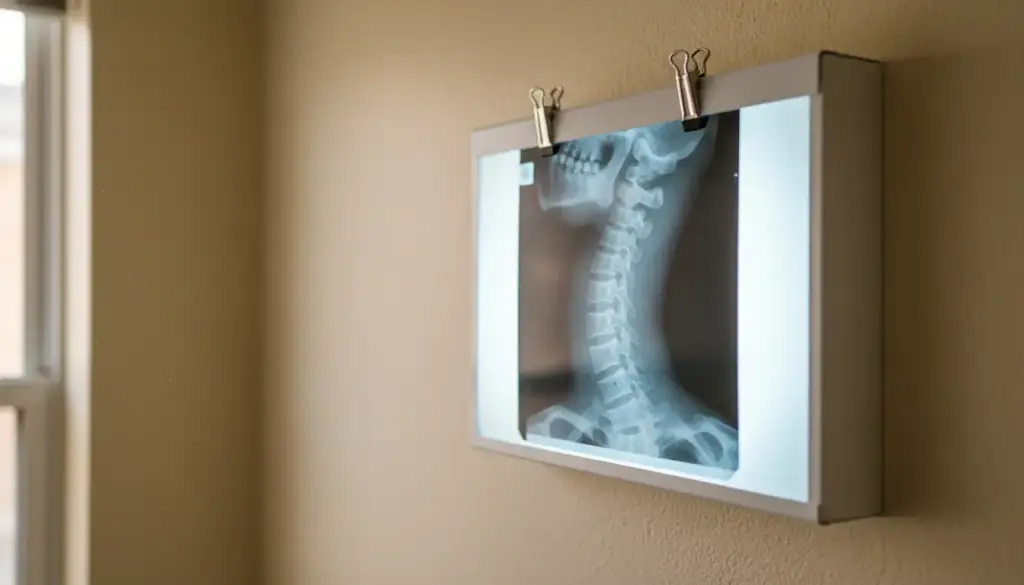
Lateral cervical spine x-ray film clipped to a lit wall viewer
What the films show the doctor
A spinal x-ray shows structure, and structure answers questions the hands can only suggest. The doctor can see how the vertebrae stack and whether the normal curve of the neck or low back has changed, how much space remains between the bones where the discs sit, and whether a bone carries an old fracture, a healed injury or an unusual shape that makes certain techniques a poor choice.
Films also show signs of wear. Degeneration appears as narrowed disc spaces or changes along the edges of the bone, and knowing that is in the picture changes how gently or how specifically a joint is approached. If a film shows something that calls for a different kind of care, the doctor will tell you plainly. For Dr. James Smith and Dr. Justin Smith, the x-ray is a safety step as much as a diagnostic one.
From film to plan, in the report of findings
Taking the films is not the end of the visit. At the report of findings, the doctor puts the history, the exam and the x-rays together and explains them in plain terms, often pointing at the film itself. You see what the doctor sees: where the alignment has shifted, where a disc space is narrow, and why one side of your neck may have been protesting for months.
That conversation leads to the recommended course of care: which joints to adjust, whether the activator treatment suits you better than a manual adjustment, and how often to come in. Dr. James Smith has practiced in Tyler since 1977, and Dr. Justin Smith has worked beside him since 2002. Call (903) 595-2664 to arrange a free consultation, or read about our chiropractic adjustments first.
Family-owned in Tyler since 1977.