Muscle knots
Trigger point therapy
Sustained, specific pressure on the tight knots that refer pain into the head, shoulder or hip.
The knot in your shoulder that puts an ache behind your eye
A trigger point is a small, taut band inside a muscle that stays contracted when it should let go. Under a thumb it feels like a firm bead, and it is tender in a way that surprises people. Desk work, a long commute across Tyler, carrying a toddler on one hip, or an old injury that never fully settled can each leave one behind. Dr. James Smith and Dr. Justin Smith find them by hand, the way this family practice on South Baxter has since 1977.
The tricky part is that a trigger point rarely hurts where it lives. A knot in the upper shoulder can send an ache up into the temple and behind the eye, which is why some headaches and migraines turn out to start in the muscles of the neck and shoulder. A knot in the buttock can imitate sciatica down the back of the leg. Treating only the spot you point to misses the source, so the exam follows the pain back along the muscle.
We start the way every new patient does, with your health history, then an exam, with x-rays when the picture calls for them. Then the doctor presses. When a tender spot reproduces the pain you came in with, even though it sits an inch or a foot away from it, that tells us we have found the cause and not just the complaint.
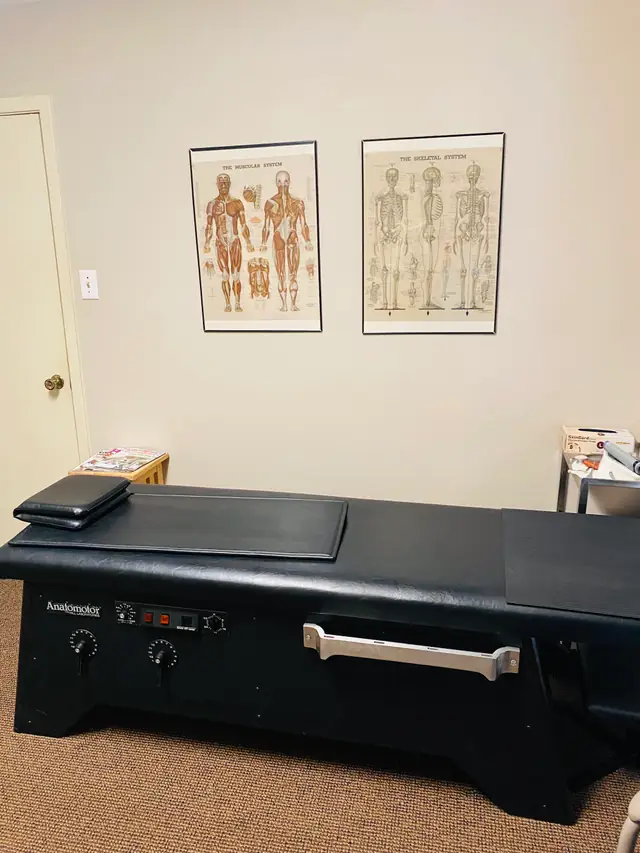
Framed muscular system chart above a black treatment table
Steady pressure, held until the muscle lets go
Releasing a trigger point is slower than most people expect and gentler than they fear. The doctor locates the knot, presses into it with a thumb or knuckle until you feel the familiar tenderness, and then holds. The hold is the treatment. Under steady pressure the tight fibers soften, and the spot that made you wince becomes easier to touch. You tell us how it feels, and the pressure changes to match.
Some soreness afterward is common, a little like the day after a hard workout, and it fades. When a muscle is angry we can pair the pressure with therapeutic ultrasound or a cold pack, and when a stiff joint is keeping the muscle guarded we add an adjustment. Muscle and joint feed each other: a locked segment keeps the muscle tight, and the tight muscle keeps the segment from moving. Treat only one and the other holds the pattern in place.
Keeping the knot from coming back
A released trigger point returns if the habit that built it stays. So we ask what your day looks like: hours at a screen, a phone cradled against one shoulder, a bag that always rides the same side, a workout that hammers one muscle group. Small changes matter. Raise the monitor to eye level, switch hands, stand and walk a couple of minutes each hour, and the same muscle stops carrying a load it was never built for.
Home stretching does the rest. The doctors show you one or two stretches for your problem area, the kind you can do beside the kitchen counter, held gently until you feel the stretch and never to the point of pain. For weekend athletes with sports injuries that usually means hips and calves. For desk workers it is the chest, the neck and the muscles between the shoulder blades.
If your pain has lasted for weeks, or came with numbness, weakness or fever, tell us right away, because some pain needs a different workup. Otherwise, bring us the muscle pain you have been living with. Call (903) 595-2664 to book a free consultation at 945 S. Baxter Ave in Tyler, and show us where it hurts.
Tyler Chiropractic — Most major insurance accepted, including BC/BS, Medicare and United Healthcare. Call 903-595-2664.